

Oneonta shop slabs, ground and sealed instead of coated
A bare shop slab sheds dust and soaks up oil long before it actually wears out. Taylor grinds it open so a sealer can soak in, with a stain first if you want color, and the concrete you already own comes back looking finished.
Three passes on a bare shop floor
Blount County is full of detached shops and pole barns, and the slabs inside them run the whole range, from smooth and sound to cracked and dusty with years of oil drips worked into them. A lot of those floors do not need a decorative coating at all. What they need is to quit shedding dust and quit soaking up every spill. A grind and seal does that job well, and for a working shop it is often the honest answer. The work on the slab comes in three passes, and the second one is up to you.
Opening the surface
A troweled slab has a tight, closed skin, and a sealer laid on top of that skin just sits there until it wears away. The diamond grinder cuts the skin off so the sealer can soak into the concrete itself. The same pass takes up old paint, glue and dried spills, and it evens out the rough spots.
Color, if you want it
Stain is optional. Acid and water-based stains color the concrete from within, which is how the shop at the top of this page ended up a warm amber. If you would sooner keep plain gray concrete, the step is simply left out and the slab goes straight to sealer.
Seal and burnish
A penetrating sealer leaves a natural matte look. A film-forming sealer gives you gloss and stronger stain resistance, which earns its keep in a shop where oil and fluids end up on the floor. Either way, the slab is buffed to an even sheen at the end.
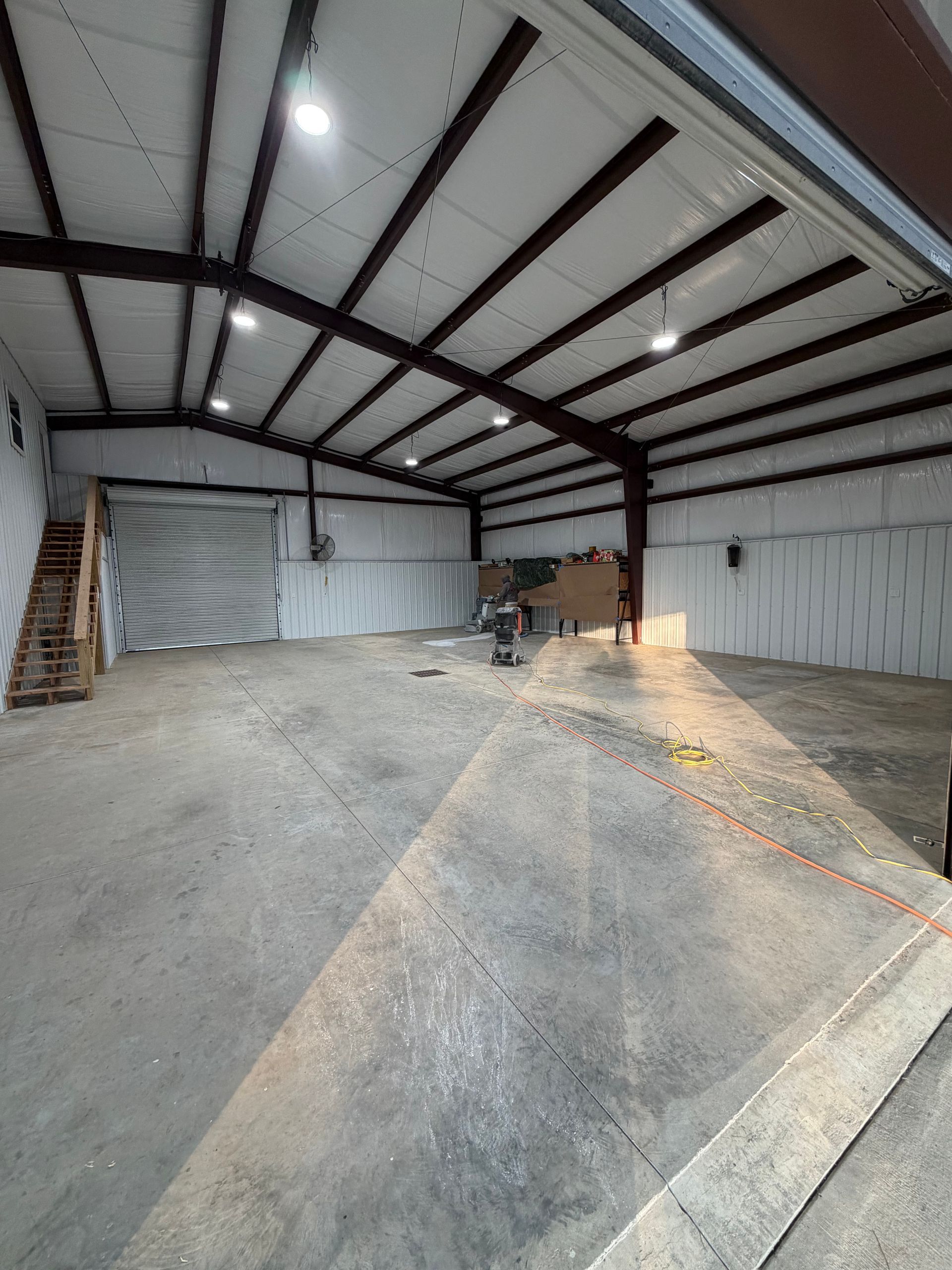
The same shop before the grinder started
This is the steel-frame shop from the top of the page before Taylor did anything to it: a dusty bare slab, extension cords and a grinder near the roll door. Raw concrete like that gives off a fine dust every time a boot or a tire scuffs it, because the top layer is slowly coming apart. Sweeping only turns up more of it, and the dust ends up on every shelf and every tool in the building.
Grinding and then sealing hardens that surface so it stops dusting, and a slab that needs extra help gets a densifier first. The finished floor, stained amber and glossy under the shop lights with the brown steel beams overhead and the wooden stair up to the loft, is the photo at the top of this page. Each step, from the grind to the burnish, is on the concrete sealing and grind and seal page, and the gallery of finished floors shows where Taylor’s other slabs ended up.
Deciding between a sealer and a full coating
A grind and seal costs less than a full coating system, and Taylor will tell you so when it suits the building. A pole barn full of equipment or an older shop slab with some character to it are both good candidates. You keep the look of the concrete you already own, and there is no film sitting on top of it waiting to peel. Vehicles can go back in after two to three days, which is quicker than a full flake build.
Where sealing goes wrong is a slab that has to look uniform. A sealer brings out everything already in the concrete, old patches and stains included, and a stain pushes that further still. If you want one even color across the whole floor, a coating is the better fit. Slab quality varies so much from one building to the next out here that the first visit is a real inspection, and Taylor makes that call standing on your floor.
You deal with Taylor from the first call to the walk-through at the end. His training came from Brian Phillips, The Epoxy Dude, in southern Indiana. Shanks Concrete Coatings is Taylor and Heather’s company, founded in 2025 and licensed and insured in Alabama under #2602341. If you want to know which way your floor leans, send over the details of the building and he will come take a look.
Stamped concrete and a sealer that is wearing thin
Sealing is plenty useful outside the shop too. Stamped porches, patios and driveways all take a sealer, and outdoors the sun and foot traffic wear it down faster than anything indoors ever will. If your porch needs a full textured finish with real grip instead, the patio and porch coatings Taylor lays in Oneonta are the other route.
Resealing stamped concrete
An old sealer on a stamped patio goes cloudy and patchy with age. It comes off before the new coat goes on, because sealing over it locks that cloudiness in for good. Then you pick the look: film-forming for a deeper, wet color, or penetrating for something closer to bare concrete. Both get sampled on your slab first.
Knowing it is due
Outdoors, plan on several years between coats depending on sun and traffic, and indoors considerably longer. Watch what rain does to the surface. Once water darkens the concrete where it used to sit up in beads, or the sheen has gone dull along the path people walk, it is time. Call Taylor at (256) 365-6535 or tell Taylor what the slab is doing.
More floor work around Oneonta
If sealing is not the right fit, one of these probably is.
Garage Floor Epoxy
Attached garages that see a truck daily.
Flake Epoxy
Outbuildings, shop offices and basements.
Patio Coatings
Covered porches, carports and patios.
Polyurethane Floors
Solid color shop floors with a tough topcoat.
Oneonta, AL
Every floor system, Oneonta wide.
Concrete Sealing
The full build-up, step by step.
What people ask before a shop slab is sealed
Why does my bare shop slab keep making dust?
Because the surface is slowly breaking down under boots and tires, and every bit that breaks off becomes fine powder. A penetrating sealer, or a densifier on a slab that needs it, hardens that top layer so it stops shedding. That alone is the reason a lot of shop owners call.
Will sealing make my concrete darker?
It depends on the sealer. A film-forming sealer deepens the color the way concrete looks after a rain, and it adds gloss. A penetrating sealer barely changes the look at all. Taylor puts a sample of each on a corner of your slab so you can pick with the real concrete in front of you.
Can you stain the floor as part of the job?
Yes, it is optional. An acid or water-based stain colors the concrete from within, so it reads as part of the slab itself. The shop at the top of this page went amber. Stain shows every old patch and mark, so Taylor walks the slab with you before you commit.
How long before I can drive back into the shop?
Foot traffic is fine after about a day. Vehicles wait two to three days while the sealer finishes curing. Grinding is the loud part, so if the shop is also where you work, plan to be elsewhere while the grinder runs, and move anything you need off the floor beforehand.
How often does sealed concrete need doing again?
Outdoors, a sealer usually lasts several years, depending on how much sun and traffic the slab gets. Indoors, in a shop or a pole barn, it lasts considerably longer. Taylor can tell you on a visit how much life is left in the sealer you have now and whether it needs stripping first.
Would you tell me if a seal is all my floor needs?
Yes. If a grind and seal suits the way you use the building, that is what Taylor recommends, even though it is the smaller job. It keeps the character of the concrete, and on an older shop slab or a stamped patio it is often the better-looking finish anyway.
Find out if a seal is enough
Send over a few photos of the slab and a rough size, and Taylor will come look at the concrete before he puts a real number on it.