
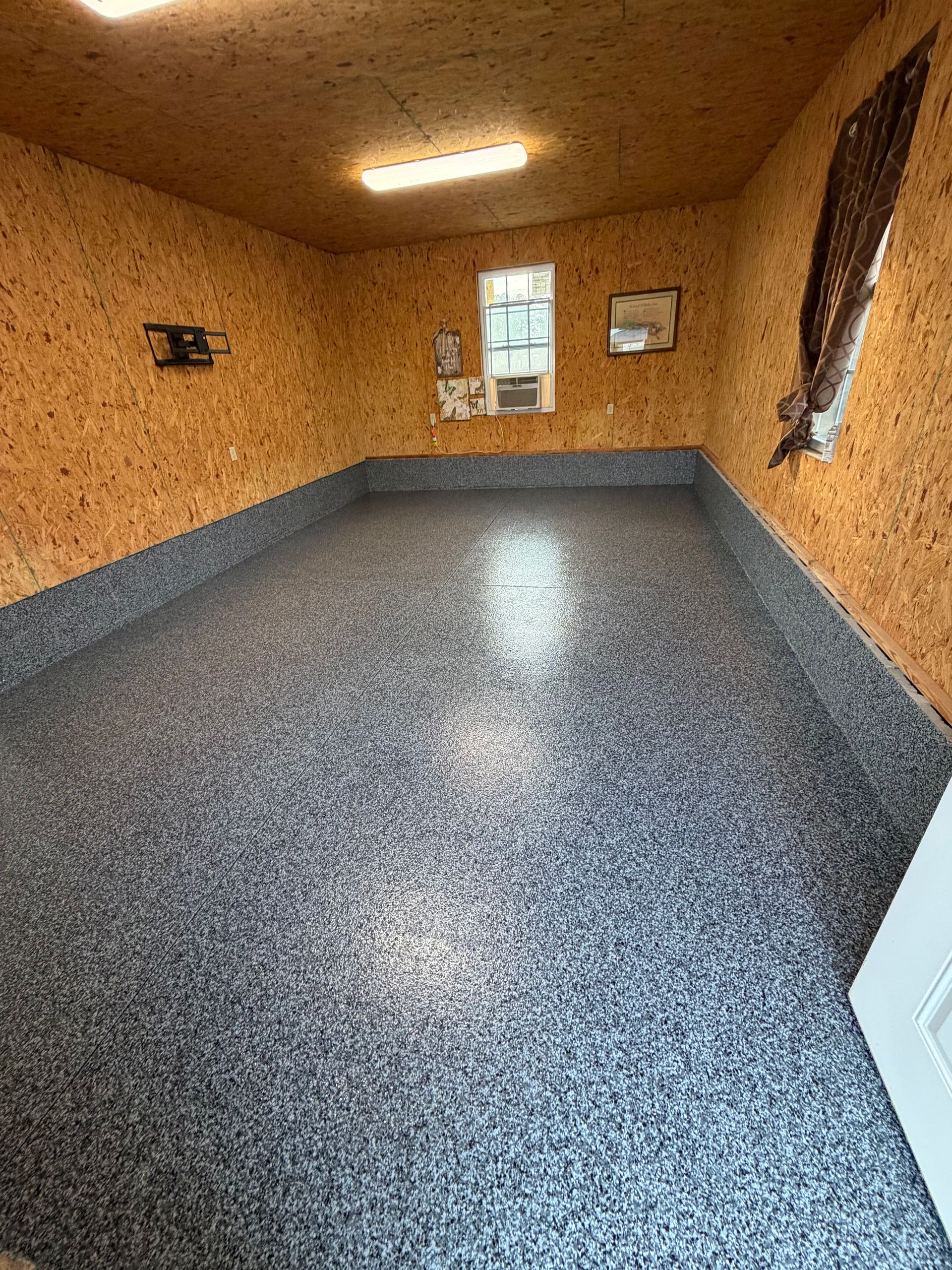
Flake floors for Oneonta outbuildings and basements
A finished outbuilding or a basement asks different things of a flake floor than a garage does. Taylor tests the slab for moisture, grinds it open, then throws chip until the base will not hold any more and locks it all under clear.
Flake for the rooms that were never a garage
Most people picture flake on a garage floor, and around Oneonta plenty of it still goes there. Blount County also has a lot of detached shops and outbuildings on its rural lots, and more of them are getting finished into rooms people actually spend time in. The floor at the top of this page is one of those: gray and white flake carried up OSB-lined walls, with a window AC unit and a mount for the TV. Taylor builds it with the same system he uses in a garage. What changes is the slab he starts with and what the room has to put up with afterward.
The finished outbuilding
A building that started as storage and turned into a hangout room usually sits on a slab nobody thought much about when it was poured. Flake suits it well. The chip hides the dust that blows in through an open door, and it hides the odd crack repair Taylor makes along the way.
The office end of the shop
Running a business from a shop at home means paperwork in one corner and work boots tracking through everywhere else. Flake in the office end looks finished and cleans up with a damp mop. The clear topcoat takes the chair casters that roll back and forth across it all day.
The basement
Below grade, flake earns its place in a laundry corner, a home gym or a family room. It is far easier on the eye than bare concrete, and the texture keeps it from feeling slick in socks. The one condition is moisture, and that gets checked before anything else happens.
Detached and below-grade slabs get a moisture test
The photo here is a basement Shanks finished in blue, black and white flake, with the room’s poured concrete walls and wood cabinets around it. A basement slab sits against damp ground all year, and water vapor works up through it whether or not you ever see a wet patch. Trap that vapor under a sealed coating and it gathers underneath until the floor lets go in sheets. Detached buildings carry the same risk from another direction, because a shop or outbuilding slab may have gone down with no vapor barrier under it, and the surface will not tell you either way.
So before Taylor prices one of these floors, he measures the slab with a calcium chloride kit or a relative humidity probe. A good reading means the normal build. A high one means a mitigating primer goes under the base coat, and you hear about it before the grinder comes off the trailer. After that the slab is ground to a CSP 2 to 3 profile and the base goes down. Every coat in the build is laid out on the flake epoxy floors page, and there are more finished rooms in the Shanks gallery.

Choosing a chip blend and how it feels underfoot
Blends are mixed to the room, never pulled off a chart. Gray and white is the forgiving choice for an outbuilding where the door stays open half the day, since dust and dried mud disappear into it. Blues read cooler and suit a basement or a game room where the floor is part of the look, like the one in the photo above. Taylor lays a sample board on your slab so you judge the blend in your own light, which in a shop building is rarely anything like a showroom’s.
People also worry that a glossy floor will be slick. Flake has more bite than a smooth coating, because the chip edges break up the surface under the clear. Where water reaches the floor often, at a walkout door or beside a utility sink, the topcoat can carry a fine aggregate for extra grip. If you cannot settle on a blend, send Taylor a photo of the room and he will bring sample boards that suit it. Most of the flake he lays is still in garages, and James R. had this to say about his.
Shanks Concrete Coatings did an awesome job in coating our garage. They are very professional and takes great pride in their work. I highly recommend this company as they are tops in their field.
James R.
A coved floor you can scrub and rinse
A room inside a shop building collects grit along the wall line faster than anywhere else on the floor. Carrying the flake up the wall turns that corner into one continuous surface, and that is what lets you clean the room properly. If the space is more workshop than office and you would sooner have one solid color with a harder-wearing finish, read about the solid color polyurethane floors Taylor puts in Oneonta shops.
The cove at the wall
The chip runs four to six inches up the wall in a smooth curve, so there is no seam at the floor line for dirt or spilled water to settle into. Taylor preps the base of the wall while the grinder is already out, which means the cove gets decided on the first visit.
Cleaning it for years
With the cove in and the clear sealed over the chip, a mop bucket and a stiff brush handle most of the upkeep, and nothing soaks into the concrete. If you want to talk through whether your building suits flake, call Taylor at (256) 365-6535 or describe the building to Taylor.
More floor work around Oneonta
Same grinder, different room. These are the other floors Taylor writes up for town.
Garage Floor Epoxy
Attached garages that see a truck daily.
Concrete Sealing
Grind and seal for shops and barns.
Patio Coatings
Covered porches, carports and patios.
Polyurethane Floors
Solid color shop floors with a tough topcoat.
Oneonta, AL
Every floor system, Oneonta wide.
Flake Epoxy
The full build-up, step by step.
What Oneonta owners ask before a flake floor
Can flake go on a slab in a building with no vapor barrier?
Often, yes, but only after the slab is tested. Taylor measures it with a calcium chloride kit or a relative humidity probe. A good reading means the normal build goes down. A high reading means a mitigating primer under the base coat first, and you are told that before any grinding starts.
How thick is a flake floor once it is finished?
Typically 20 to 30 mils with the base, the chip and the clear all in place. That is several times what a roller of floor paint leaves behind, and it is why the floor covers small surface flaws and stands up to chairs, boots and furniture being moved around on it.
Will a flake floor fade near a window or an open door?
The polyaspartic topcoat is UV stable, so the color holds where the sun hits it through a window or across the threshold of a shop door left open in summer. That matters in an outbuilding, where the door is often open for most of the working day.
Can I see the chip colors before you start?
Yes. Blends are mixed for the room, and Taylor lays a sample board on your floor so you see it in the light you actually have. A building lit by shop fixtures can make a blend look quite different from a photo on a phone, so it is worth the few minutes.
What keeps a flake basement floor from feeling slick?
The chip itself. Its edges break up the surface under the clear coat, so it has more bite than a smooth coating. If water reaches the floor often, at a walkout door or near a utility sink, Taylor can add a fine aggregate to the topcoat for extra grip underfoot.
What about a crack that runs the length of the building?
It gets chased out, filled and ground flush before any chip goes down, so it disappears from view. A crack that is still moving with the seasons can show a hairline back through later, and Taylor will tell you at the first visit if yours looks like one of those.
Have the slab tested first
Say what the building is used for and whether the slab is below grade, and Taylor will test it and give you a real number in writing.